Have you ever had that frustrating feeling of missing out on the soul of a country by only looking at its beautiful landscapes? For us, everything changed when we understood that Bolivian legends and traditions are not just simple tales, but the beating heart that animates every ritual and local festival. We’re taking you to discover why coca is offered to Pachamama or why the Tío of the mines is so feared – incredible stories that finally give full meaning to the adventure 🇧🇴.
- The Bolivian Spiritual Foundation: Between Pachamama and Syncretism
- Foundational Tales of the Andes: Where It All Began
- Emblematic Figures of Bolivian Daily Life
- Tales and Terrors of the Bolivian Oriente and South
- When Beliefs Come Alive: Festivals and Celebrations
The Bolivian Spiritual Foundation: Between Pachamama and Syncretism
Pachamama, More Than Just a Mother Goddess
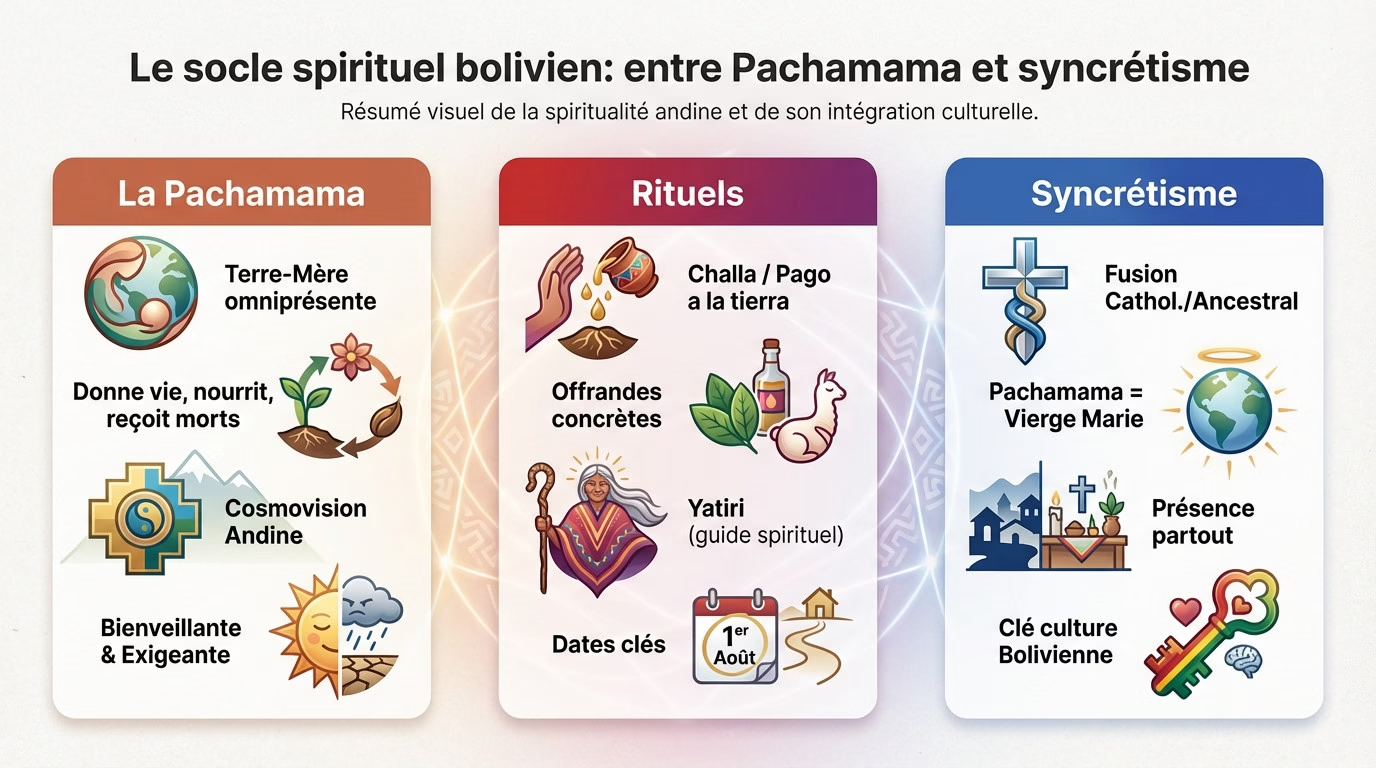
Forget simple mythology. For the Quechua and Aymara communities, Pachamama is a living entity, omnipresent in daily life. She is the Mother Earth who gives life, nourishes us, and eventually welcomes the dead, inspiring visceral respect.
This belief, long predating the arrival of the colonists, forms the hard core of the Andean cosmovision. It’s a direct, permanent, and almost carnal link with the nature that surrounds us.
Yet, she has a dual nature: benevolent, but also terribly demanding. If she isn’t shown due respect, crops rot and bad luck strikes. It’s a constant balance to maintain.
Rituals to Honor Mother Earth
We have often witnessed the Challa or Pago a la tierra ritual. It is the ultimate offering to thank Pachamama, celebrated massively on August 1st, but also before every journey or construction.
The offerings are far from symbolic. They include coca leaves, alcohol poured on the ground, food, and even dried llama fetuses for crucial requests. It’s tangible, it leaves a lasting impression.
To orchestrate all this, the Yatiri is indispensable. This Andean spiritual guide leads the ceremony and knows exactly how to interpret the signs sent by Pachamama.
When Catholic Saints Meet Andean Spirits
This is where religious syncretism truly makes sense. Bolivians have masterfully fused their ancestral beliefs with imposed Catholicism. It’s not one or the other; it’s a total and embraced coexistence.
A typical example? Pachamama is often associated with the Virgin Mary. People pray to the Virgin while pouring a drop for Mother Earth. It’s a brilliant way to preserve traditions under a Christian veneer.
This blend colors everything, from village festivals to private altars. In short, it’s the key to truly grasping Bolivian culture and its legends and traditions.
Foundational Tales of the Andes: Where It All Began
After exploring the spiritual foundation, we delved into the great myths that shaped the Andean imagination, long before the modern world arrived.
Viracocha and the Creation of the Andean World
We begin with Viracocha, the patron, the supreme creator god. According to accounts, he emerged from the icy waters of Lake Titicaca to shape the sky, the earth, and a first generation of humans… giants.
But it didn’t go as planned. Displeased with these unruly giants, he annihilated them in a massive deluge. It’s brutal, but this cleansing by water remains logical given the local geography.
For his second attempt, he did better: humans in his image, sculpted from stone in Tiwanaku. He then offered them language, customs, and precious seeds.
Lake Titicaca, Cradle of the Sun and the Incas
This is where Bolivian legends and traditions truly come alive with Manco Capac and Mama Ocllo. Children of the sun god Inti, they emerged from the Island of the Sun with a clear mission: to find the ideal place to build an empire.
They walked for a long time, armed with a golden staff. The rule was simple: where the staff would sink effortlessly into the ground, they would found their capital. This is how Cuzco was born.
This myth is not insignificant. It legitimizes the absolute power of the Inca Empire by anchoring its divine origin in this sacred lake. Frankly, the mystical energy is still palpable when you wander there.
The Sacred Mountains, Illimani and Illampu
In the Andes, people don’t joke about “Apus.” These peaks are not just simple piles of rocks, but true protective deities. You quickly feel that they command respect from the locals.
Take the old rivalry between the giants Illimani and Illampu. Legend has it that they fought violently to determine who was the tallest. Their titanic clashes are said to have literally shaped the current landscape.
Viracocha had to intervene to calm them… by cutting off their heads. These decapitated heads became more modest peaks, like Sajama. That’s why these mountains have such a peculiar appearance today.
Emblematic Figures of Bolivian Daily Life
Exploring Bolivian legends and traditions, we quickly realized that mysticism isn’t just a museum piece. But myths aren’t just ancient stories. Some
El Tío de la Mina, the Diabolical Guardian of the Depths
We encountered El Tío in Potosí, the absolute master of underground riches. This diabolical figure with menacing horns watches over every gallery with a terrifying air. His gaze seems to pierce the total darkness of the mine.
On the surface, he’s the Devil, but underground, he becomes a vital protector. Miners offer him coca and alcohol to avoid accidents. It’s the price for finding good veins.
Neglecting this ritual exposes one to his wrath: rockfalls or sudden explosions. It’s a purely pragmatic belief in the face of an extremely dangerous profession. You don’t mess with your safety here.
Cholitas, More Than Just a Traditional Costume
Cholitas are those indigenous Aymara and Quechua women you immediately spot. It’s impossible to miss their unique attire with layered skirts, the pollera. They proudly wear a colorful shawl and that famous bowler hat. It’s truly the icon of the Andes.
This costume, once a sign of servitude imposed by the Spanish, has become a symbol of cultural pride. It’s a striking social triumph. Did you know that the tilt of their hat even reveals their current marital status?
It is said that they hold ancestral knowledge, particularly about medicinal plants. They represent a major economic and cultural force in La Paz. It’s fascinating to see their real impact on commerce.
Ekeko, Little God of Abundance and Wishes
Ekeko is the god of abundance, fertility, and joy. He is a small statuette of a smiling, mustachioed man. He carries a mountain of miniature goods on him.
The principle is brilliant: you offer him what you wish to obtain, but in miniature. A mini-house, a wad of fake bills, or a diploma. It’s a way to materialize your dreams.
For the wish to come true, you have to “make the cigarette smoke” in his mouth. It’s an essential ritual, especially during the Alasitas fair. Almost every household has its Ekeko. We found this practice truly unique.
| Figure | Main Role | Where to Find Them? | Associated Ritual |
|---|---|---|---|
| El Tío de la Mina | Guardian of the Mines | In the Mines (Potosí) | Coca/Alcohol Offerings |
| La Cholita | Symbol of Cultural Identity | In Andean Cities (La Paz) | Wearing the Costume and Hat |
| Ekeko | God of Abundance | In Homes and at the Alasitas Fair | Purchase of Miniatures and Cigarette Offering |
Tales and Terrors of the Bolivian Oriente and South
The Impossible Loves of the Amazon Rainforest
We’re radically changing scenery for Eastern Bolivia, a much more tropical area. There, you often come across the Bibosi and Motacú, two trees that always grow intertwined.
It’s actually the story of a tragic love between a chief’s daughter and a young warrior from an enemy tribe. To escape the father’s wrath, they transformed into these two trees, united for eternity.
Another transformation story that struck us is that of the Guajojo bird. Its melancholic song is said to be that of a young girl transformed into a bird after the brutal death of her lover.
Frightening Creatures That Haunt the Nights
At night, you really avoid encountering the Viudita, a famous legend from the East. She is the ghost of a woman who seduces unfaithful or drunk men, before revealing her skeleton face to punish them.
Heading south, you’re wary of the Silbaco bird. It’s not an ordinary bird, but a half-man, half-bird creature whose horrible cry often announces death.
We were also told about the Duende, a forest spirit resembling a goblin. He likes to play tricks and sometimes kidnap unbaptized children.
Legends to Explain the World
Many of these Bolivian legends and traditions ultimately serve to give meaning to the surrounding world. It’s a poetic, almost magical way to explain natural phenomena or historical facts.
Take, for example, the legend of the potato. It is seen as a direct gift from the gods to feed hungry people.
- Other Tales That Shape Bolivia:
- Bolivianite: the story of Princess Anahi who gave her name to this unique semi-precious stone, a blend of amethyst and citrine.
- The Kantuta: the legend of two rival kings whose blood gave birth to this flower, which became Bolivia’s national flower.
- The Headless Priest: a story of divine punishment that haunts certain colonial churches in the south of the country.
When Beliefs Come Alive: Festivals and Celebrations
All these stories don’t just stay quietly in books. They
The Oruro Carnival, a UNESCO-Listed Spectacle
It’s the country’s major cultural event, something that truly moves you. The Oruro Carnival isn’t just a party; it’s a true danced pilgrimage that mobilizes thousands of people.
The foundation of this celebration is an intense blend of Andean traditions and Catholic religion through devotion to the Virgin of Socavón, patroness of miners.
- The Carnival’s Emblematic Dances:
- La Diablada: the flagship dance, representing the confrontation between the Archangel Saint Michael and the demons (symbolizing the seven deadly sins).
- La Morenada: a dance that evokes the suffering of African slaves in the Potosí mines, with exaggerated masks and costumes weighing several kilograms.
- Los Caporales: a more recent and acrobatic dance, inspired by the foremen who supervised the slaves.
The Alasitas Fair, the Market of Miniature Dreams
Every January 24th in La Paz, you can witness the curious Alasitas fair. In Aymara, “Alasita” means “buy me,” and that’s exactly the concept: it’s the time to buy your dreams for the coming year.
This tradition is linked to the god Ekeko. Once the miniatures are purchased, they are blessed by a Yatiri (shaman) and a Catholic priest.
- What can you buy at Alasitas?
- Wads of fake bills (Euros, Dollars, Bolivianos) for financial prosperity.
- Property titles, university diplomas, or miniature passports.
- Bags of cement, bricks, or entire houses, for those with a construction project.
- A miniature rooster or hen to find love.
Gran Poder and Village Festivals
It’s impossible to ignore the Gran Poder festival in La Paz when discussing Bolivian legends and traditions. It’s an immense folkloric procession that showcases the economic and social power of the city’s Aymaras, a true demonstration of faith and success.
We also think of the Urkupiña festival in Quillacollo, a gigantic Marian pilgrimage that attracts hundreds of thousands of people every year.
In short, every village has its own patron saint festival, a unique blend of religious procession, traditional dances, music, and communal meals 🇧🇴.
We loved diving into this fascinating universe where the sacred meets the everyday. Bolivia isn’t just visited,

