
What if the next wine that excites you didn’t come from Burgundy… but from Bolivia?
In this article, we explain why Bolivian wine deserves your full attention — high-altitude terroirs, little-known grape varieties, bold techniques, and intriguing aromas.
Prepare your palate for aromatic surprises and a humbling lesson for our French taste buds.
Key Takeaways
- Bolivian vineyards grow at dizzying altitudes, producing wines with vibrant acidity and intense aromas.
- Local winemakers combine European expertise and Andean traditions, creating unique and creative wines.
- Excellent value for money and an unprecedented aromatic palette make Bolivian wine a true gem for the curious.
🍇 The History of Bolivian Wine
From Spanish Roots to the Andes
Vines arrived in Bolivia in the 16th century with Spanish conquistadors, who cultivated Vitis vinifera for liturgical wine.
The first plantations were established in the valleys of Tarija and Cochabamba, between 1,500 and 2,500 meters above sea level.
These areas, both sunny and cool, produce grapes with great aromatic expressiveness.
Many small producers still perpetuate the methods of their ancestors.
👉 Fun fact: here, viticulture is not just a crop — it’s a heritage celebrated with family, often to the rhythm of local music and shared harvests.
A Distinctly Local Wine Culture
In Bolivia, viticulture has blended into popular culture.
Muscat of Alexandria reigns supreme — it’s used to produce singani, a national aromatic brandy, as well as sweet and floral wines.
Local festivals and small family bodegas remind us that wine here is, first and foremost, a collective pleasure.
But behind this conviviality lies surprising technical expertise… let’s take a closer look 👇
Bolivian Expertise: Tradition & Modernity
Bolivian winemakers combine ancestral techniques and modern winemaking:
- Fermentation in stainless steel tanks, sometimes in concrete.
- Partial aging in barrels to add complexity.
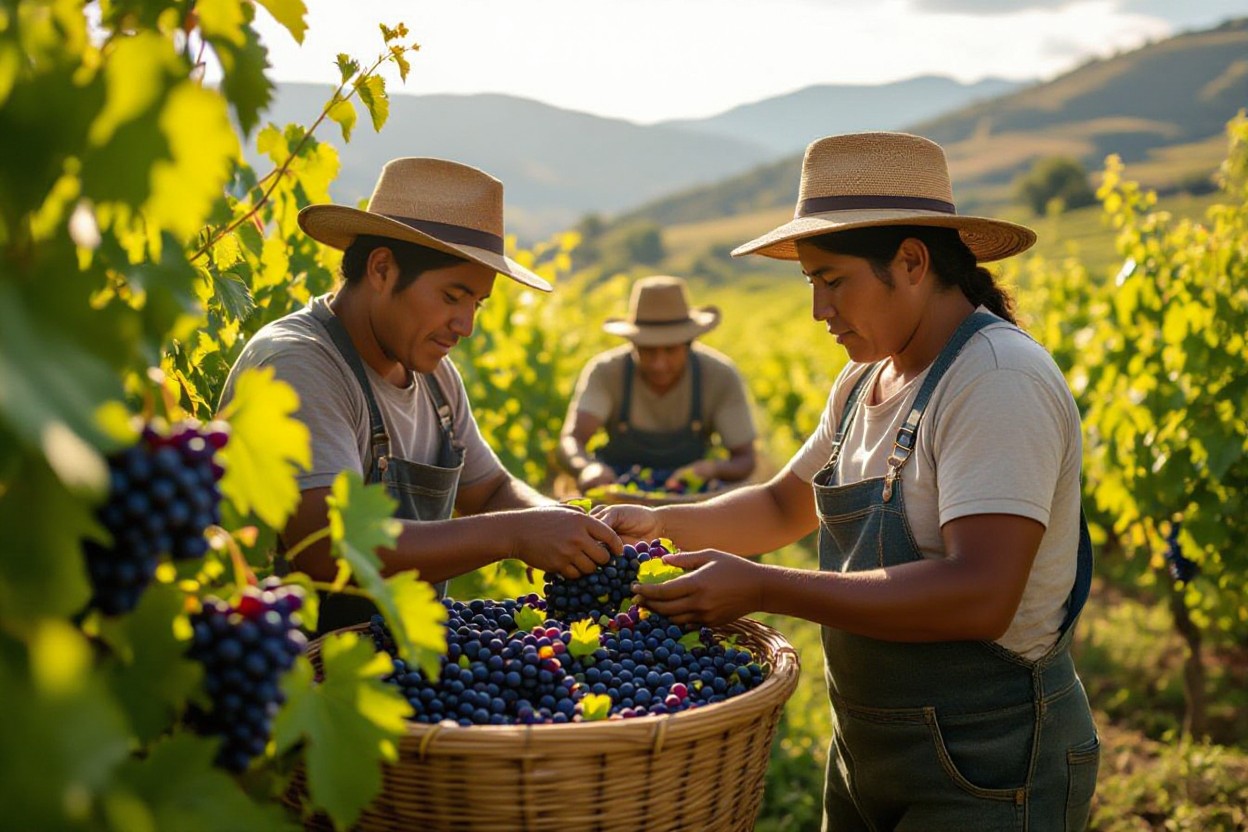
- Manual harvests and solidarity cooperatives.
Cold nights at high altitude preserve acidity, while warm days concentrate aromas.
The result: precise, flavorful, balanced — and remarkably original wines.
Major Wine Regions
Tarija, the Beating Heart of Bolivian Wine
This is the main region, between 1,800 and 2,200 m above sea level.
The reds here are powerful and fruity, the whites crisp and aromatic. Tarija embodies the perfect balance between sun and freshness.
Cochabamba, The Temperate Valley
At 2,500 m, the wines gain in finesse and aromatic expression.
International grape varieties blend with local ones here, on alluvial soils irrigated by Andean snowmelt.
The result: fresh, floral, slightly exotic wines — perfect for surprising pairings.
The Altiplano, Wine’s Extreme Frontier
Beyond 3,500 m, conditions become extreme.
The cold, UV rays, and stony soils reduce yields but concentrate aromas.
These wines often have mineral notes, marked acidity, and a rare purity.
A true playground for lovers of sensory experiences.
Grape Varieties to Discover
Local Varieties: Torrontés and Moscatel
These white grape varieties yield floral and lively wines with good tension.
Some reds come from old Malbec clones adapted to high altitude, producing powerful and spicy wines.
International Varieties: Malbec, Tannat, Cabernet, Syrah
Tannat brings structure and tannins, Malbec brings fruity richness.
Malbec-Tannat blends age beautifully.
Short macerations preserve freshness, while barrel aging adds body and depth.
👉 Even at 14% alcohol, the wines remain digestible thanks to high-altitude acidity.
A balance rarely found elsewhere in South America.
Between Tradition and Innovation
In Bolivian wineries, open concrete vats stand alongside connected fermentation sensors.
Winemakers adjust temperatures to the nearest degree, monitor sugars in real-time, and precisely manage wood aging.
This modernity allows them to produce wines capable of aging 8 to 10 years without losing their freshness.
But make no mistake: here, technology doesn’t replace human touch.
It simply helps to reveal the best of the terroir.
Food & Wine Pairings: The Adventure Continues
Bolivian wine pairs wonderfully with Andean cuisine:
- Tannat or Malbec with charque (dried meat) or alpaca grills.
- Crisp white or rosé with high-altitude trout.
- Light red with the famous salteñas (sweet and savory pastries).
The contrasts are often delicious: acidity, freshness, spices… everything balances wonderfully. 😋
🇫🇷 Tips for French Enthusiasts
- Start with a tasting trio (white, rosé, red).
- Serve young reds at 14–16°C, whites at 8–10°C.
- Decant tannic wines for 30 to 60 minutes.
- Compare a Bolivian Malbec and an Argentinian Malbec — the differences are fascinating.
- Note your impressions, the producers, the associated dishes: it’s the best school of taste.
A Sustainable and Authentic Approach
Most Bolivian wineries are family-owned and artisanal.
Harvests are manual, yields are low, and sustainable viticulture is gaining ground.
We are seeing more and more cover crops, local composts, and organic practices.
Fewer inputs, more authenticity.
These wines often have a soul that you can feel from the first sip.
In Summary: Why Bolivian Wine Will Surprise You
Because it comes from where no one expects it.
Because it combines extreme altitude, Andean microclimates, and human passion.
Because it offers pure, vibrant, unique wines — at still reasonable prices.
Dare to explore new horizons.
Bolivia is far from done making a name for itself… in our glasses. 🍷✨
❓FAQ
Q: What makes Bolivian wine so unique?
👉 The altitude! Between 1,800 and 2,800 m, warm days and icy nights concentrate the aromas. Yields are low, and the work is manual — each bottle is a rare and expressive piece.
Q: Which grape varieties should you try first?
👉 Malbec for roundness, Tannat for structure, and Torrontés for its floral freshness. Muscat of Alexandria remains a must-try for lovers of singani and aromatic wines.
Q: Where can you buy Bolivian wine in France?
👉 At a few specialized wine shops or online via independent importers. Fairs dedicated to Latin America are also good places to discover these gems. Expect to pay 15 to 40 € per bottle depending on rarity.
And if you can’t find any… organize a Bolivian tasting party with friends. You’ll at least have a good excuse to open one more bottle 😏

