To get to the heart of the matter: mastering a few local expressions like the famous “yapa” or the gentle “caserita” changes the whole experience. This linguistic effort is an instant ice-breaker and shows deep respect for Bolivians. In a country with 36 official languages, daring to utter a word in Quechua is the ultimate sesame for warm exchanges. 🇧🇴
Do you dread being silenced by a minibus driver or coming across as an aloof tourist by ignoring local codes of politeness? Don’t worry, we’ve compiled the essential vocabulary for your trip to Bolivia, so you can turn every awkward interaction into a warm and memorable exchange. From the secrets of how to negotiate your “yapa” with a smile to the slang expressions that will surprise Bolivians, this practical guide gives you all the keys you need to break the ice and experience total immersion in the heart of the Andes 🇧🇴.
- The basics to break the ice and avoid looking like a lost tourist
- Speaking like a local: Bolivian jargon for blending in
- Getting around in Bolivia: transport vocabulary
- At restaurants and markets: stress-free ordering
- Handling glitches and emergencies: life-saving phrases
- Everyday practicalities: from vending machines to toilets
- Beyond Spanish: a gesture towards Quechua and Aymara
- Going further: creating links and understanding culture
The basics to break the ice and avoid looking like a lost tourist
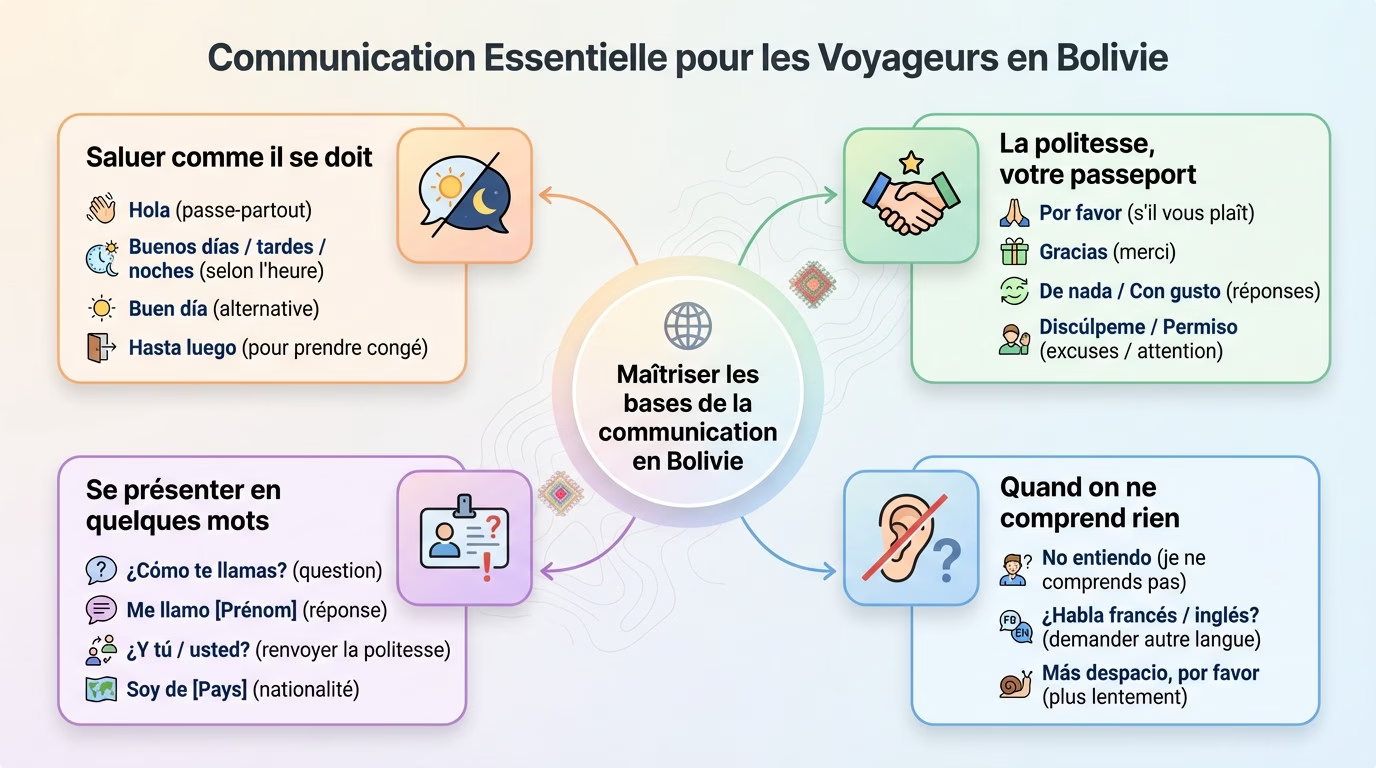
A proper greeting at all times
We often think that a simple “Hola” is enough everywhere, but this is a beginner’s mistake. In Bolivia, adapting your greeting to the specific time of day is a mark of respect that changes everything.
In the morning, start with a frank Buenos días. In the afternoon, move on to Buenas tardes, and finish with Buenas noches in the evening. For a more local feel, “Buen dia” also works great.
When it’s time to leave, the absolute standard is Hasta luego. It’s the exact equivalent of our “goodbye”, even if we never meet the person again.
Politeness, your best passport
If you only remember two elements of this essential vocabulary for your trip to Bolivia, it’s this: Por favor and Gracias. These words literally open every door 🔑.
When someone thanks you, answering “De nada” is the basic reflex. But we loved the use of “con gusto” (with pleasure), a much warmer and more frequent alternative.
In the crowded markets, a little Discúlpeme or “permiso” is always appreciated to politely make one’s way without jostling.
Introduce yourself in a few words
Bolivians are curious, so expect to hear a lot of “¿Cómo te llamas? It’s theclassic ice-breaker when you meet someone on a street corner.
The answer is simple and effective: Me llamo [your first name]. To keep the exchange going, return the ball with a “¿Y tú?” or the more formal “¿Y usted?
You’ll also be asked where you’re from. Just say Soy de Francia or Soy francés / francesa. This often launches the discussion on Europe as a bonus.
When you don’t understand: confess without panicking
It’s happened to us plenty of times: total emptiness in the face of an interlocutor. Just say No entiendo. It’s the basis for avoiding embarrassing misunderstandings, and there’s no shame 😅.
Try your luck with a ¿Habla francés / inglés? but be careful not to bet too much on it. Outside the tourist areas, English is rarely spoken by locals.
If it goes too fast, just ask “Más despacio, por favor”. People will slow down with a smile.
Speaking like a local: Bolivian jargon for blending in
Now that you’ve got the basics of survival down pat, let’s step up a gear with this must-have vocabulary for your trip to Bolivia. To really connect with Bolivians, you need to understand their own little expressions.
Caserita and yapa: market secrets
At the market, if someone throws you a “¡Hola caserita!”, don’t be surprised 🍅. It’s a term of endearment that vendors use for a loyal customer. If someone calls you that, it’s a really good sign! You can even use it in return.
Then there’s the famous yapa, or yapita for those in the know. It’s that little free extra, that bonus that the seller spontaneously offers you. It’s a pure gesture of sympathy.
We advise you to ask nicely “¿Y la yapita?” after a purchase. At best, you’ll get a little gourmet bonus. At worst, you’ll get a big, knowing smile.
The magic of diminutives in -ito and -ita
Bolivians love to add the suffixes -ito or -ita to the end of almost every word. It’s not about size. It instantly sweetens any conversation.
Let’s take some concrete examples: “un momento” often becomes “momentito”. Similarly, “ahora” becomes ahorita, which can mean “right away” or… “in a little while”.
In fact, it’s a mark of kindness and familiarity, not a question of size. It’s purely emotional.
The word “gringo”: should we be offended?
It’s time to demystify the term gringo or gringa. In Bolivia, it simply refers to a foreigner, often white and non-Spanish-speaking. That’s just a factual description. You really do hear it a lot over there.
Rest assured, it’ s not an insult. You’ll hear it everywhere on the street, in most cases without any pejorative connotation. It’s just a local habit.
Taking it with a smile is the best reaction 😄. It shows you’ve got the local codes right.
Everyday expressions you need to know
In La Paz, you’re bound to hear the famous ¡YAaaaaa! It’s a typical exclamation expressing surprise or irony. Locals often use it to gently poke fun at a joke. It’s very funny to hear.
You’ll also hear “No hay”, often shouted by hurried minibus drivers. It means “there’s no more room. “ It’s often accompanied by a hand gesture 🚐.
In Bolivia, a simple purchase is not a cold transaction. It’s a relationship where the ‘yapa’ symbolizes shared trust and ‘buena onda’.
Getting around in Bolivia: transport vocabulary
Once you’ve mastered this essential vocabulary for your trip to Bolivia, it’s time to get moving. Transportation here is an adventure in itself, and believe us, knowing these few phrases will save the day more than once.
Take the bus, minibus or trufi
The bus reigns supreme on Bolivian roads. To avoid ending up at the other end of town by mistake, the basic question remains: ¿Este autobús va a Cochabamba? Simple and terribly effective.
For longer journeys, head for the “nozzle terminal”, a veritable hive of activity. This is where negotiations sometimes take place, so we always ask: ¿Cuánto cuesta un boleto a La Paz? Prices vary, so have your best Spanish ready.
A detail that makes all the difference: always ask if the route is “directo”. If there are stops, the time difference is enormous.
Timetables and tickets: finding your way around
The last thing you want is to miss your departure because of a misunderstanding about the timetable. The magic phrase is: ¿A qué hora sale el autobús? Be precise, as schedules are sometimes… flexible.
You’ll often be told: “Sale a las diez de la mañana”. Beware of the nuances between “mañana”, “tarde” and “noche”. A vocabulary error here, and it’s a night of waiting on an icy bench.
A word of advice: buy your “boleto” a little in advance for popular routes. Waiting until the last minute is often a risky gamble.
Ask for directions like a pro
It’s normal to get lost in the back streets. Start with a polite “Disculpe”, then ask: ¿Dónde está la estación? Locals are usually delighted tohelp a lost traveller.
You need to pick up the answer quickly: “a la derecha”, “a la izquierda” or “todo recto”. If someone says “en la esquina”, just look for the corner. It’s survival vocabulary.
Remember the word cuadra. It’s the local unit of measurement: “A dos cuadras” means just two streets away.
Useful phrases for all types of transport
Here’s a handy little memo we always kept on hand to deal with the most common situations in Bolivian transport.
- ¿Cuánto cuesta hasta el centro? How much does it cost to get to the center? A must before getting into a cab.
- ¿Para en la plaza? Does it stop at the square? Useful for minibuses.
- ¡Bajo en la esquina! I’m getting off at the corner! To be shouted loudly to the driver.
- Me gustaría ir a… I’d like to go to… A more polite formula.
- ¿Es seguro? Is it safe? A legitimate question, especially at night.
At restaurants and markets: stress-free ordering
Travel is also about tasting. And for that, you need to know how to order. Here’s a glossary of terms to help you enjoy Bolivia’s restaurants and bustling markets.
Magical restaurant formulas
On entering or leaving the restaurant, a warm ¡Provecho! is thrown to the other tables. It’s a local custom we’ve come to love, and one that changes everything. It’s an instant icebreaker with the locals.
To order, the simple “Quisiera…” saved us many a time in the beginning. If you’re unsure about the menu, the question ¿Qué me recomienda? is still the best option. We discovered some culinary nuggets.
At the end of the meal, it’s imperative to ask the waiter for La cuenta, por favor. The bill never arrives alone on the table here. It’s always up to you to make the first move.
Watch out, it stings! Managing the “picante
Bolivian cuisine can be surprisingly fiery, in our experience. Before ordering, we always asked the waiter: ¿Este plato es picante? Better safe than sorry with our unaccustomed palates.
For sensitive stomachs, remember Sin picante, por favor by heart to survive 🌶️. Otherwise, try the “con poco picante” for a taste. It saved us a few cold sweats during our stay.
Often, the famous “llajwa” arrives separately in a small bowl on the table. So you can measure out the intensity of the chilli yourself.
Drinks, health and Pachamama
At the moment of toasting with an audible ¡Salud! we observed a precise and surprising ritual. Before the very first sip, a few drops of alcohol are poured onto the floor. It’s an automatic gesture here.
This symbolic gift is a direct offering to Pachamama, the Andean Mother Earth. We thank her for this moment of sharing. We felt it was very touching to respect this age-old tradition.
If you’re thirsty, ask for a cold cerveza or simply a vaso de agua to keep hydrated. Lovers of fresh fruit will prefer to order “un jugo”.
Essential food vocabulary
Here’s the essential Vocabulary for your trip to Bolivia, a real survival kit for eating. We’ve used these basic phrases every day to make sure we never go hungry.
Keep this list handy:
- Tengo hambre / Tengo sed: I’m hungry / I’m thirsty.
- Soy alérgico/a a… I’m allergic to… (very important).
- El desayuno, el almuerzo, la cena: Breakfast, lunch, dinner.
- ¿Aceptan tarjetas de crédito? Do you accept credit cards? (The answer is often “No, solo efectivo” – No, only cash).
- Para llevar, por favor: To take away, please.
Handling glitches and emergencies: life-saving phrases
We won’t lie to you: problems are part and parcel of traveling. But knowing the essential vocabulary for your trip to Bolivia can turn a big scare into a simple anecdote. Here’s your verbal survival kit.
When health fails: doctor and pharmacy
It happened to us after a dodgy meal, that’s the basics. Just say “Me siento mal” or “No me siento muy bien” to alert the locals. It’s clear and direct.
If it doesn’t work, you have to act fast. Ask: ¿Dónde puedo encontrar una farmacia? for small aches and pains. If it’s more serious, ask: ¿Dónde está el hospital más cercano?
Remember these words that save the day: médico/médica, medicamentos and especially me duele to localize pain.
Calling for help and reporting danger
Sometimes adrenaline rushes and you forget everything, but that word has to come out on its own. Shout ¡Ayuda! to attract attention. In the event of a critical incident, shout ¡Necesito ayuda!
To warn others of an imminent risk, let out a loud ¡Atención! The word Peligro written on a sign should also make you turn around immediately.
As an added bonus, the term Emergencia is universal and understood by everyone, even in remote areas.
I’m lost: finding your way home
It happens even to the best, especially in the labyrinthine alleys of La Paz. Just admit it: Estoy perdido / perdida depending on your gender. Bolivians are often very helpful.
Once you’ve made your confession, it’s time to go home. Approach someone politely: “Disculpe, estoy perdido. ¿Dónde está el hotel [hotel name]?”. This is the magic phrase for getting directions.
A little tip from old backpackers: always keep the address of your accommodation on a piece of paper in your pocket.
Administrative problems: passport and police
Knock on wood, but if your papers go missing, head for the police station. Ask for the “estación de policía” as soon as possible. The key word to hammer home is pasaporte.
In front of the agent, be clear and to the point to save time. Say firmly:“Necesito denunciar un robo“. It’s formal, but essential for the procedure.
A golden tip: always keep a photocopy of your passport stashed somewhere other than the original.
Everyday practicalities: from vending machines to toilets
Having dealt with medical emergencies, let’s get back to the little everyday questions. The ones that seem trivial, but without the right vocabulary for your trip to Bolivia, can become a real logistical headache.
Money: paying and withdrawing
The phrase you’ll repeat a hundred times a day at the market or on the bus: ¿Cuánto cuesta? (How much does it cost?). It’s simple, effective and avoids unpleasant surprises when it’s time to pay the bill.
When cash ran short, we often looked for a machine. To find a vending machine, ask: ¿Hay un cajero automático cerca? (Is there an ATM nearby?). The word banco (bank) is also useful for making yourself understood quickly.
Be aware that cash (efectivo) is king in Bolivia, especially outside the big cities and chic hotels where cards are refused.
The most important question: where are the toilets?
It’s the survival phrase par excellence on our long bus journeys: ¿Dónde está el baño? (Where’ s the bathroom?). No one will judge you, it’s a universal and urgent request 🚽.
We were often met with a vague gesture or “allí” (over there), or even “al fondo” (at the bottom). The word baño is universally understood, even in the remotest corners of the Altiplano where facilities are basic.
Remember to carry some change, as public toilets often charge a fee and don’t give change.
The passing of time: hours and days
Schedules are sometimes flexible, but asking the time is easy: ¿Qué hora es? (What time is it?). This often helped us find out if we’d missed the last collectivo.
To organize our excursions, we juggled with this basic temporal vocabulary: Hoy (today), mañana (tomorrow), and ayer (yesterday). It’s extremely useful for planning your visits without getting tangled up with the local guides.
We also always used ¿Cuándo? (When?), which is a fundamental question for organizing our days and transportation around the country.
Express your tastes and desires
When you see a magnificent landscape or a tasty dish, to say you love something: Me encanta. It’s strong and positive, and Bolivians really appreciate this sincere enthusiasm on the part of travellers.
On the other hand, you need to know how to say stop politely. To say you don’t like it: No me gusta. It’s polite but clear. It’s very useful if you’re offered something you really don’t want to eat.
Add “Me gustaría…” (I’d like to…) to express a wish or desire in a gentle way, it always goes down better.
Beyond Spanish: a gesture towards Quechua and Aymara
Spanish will get you out of any situation, that’s for sure. But Bolivia is a plurinational state. Learning a few words of the native languages is more than a gadget, it’s a bridge.
Why make the effort?
Bolivia officially recognizes 36 languages, an incredible diversity that defines the country. Quechua and Aymara largely dominate after Spanish, especially in the countryside and the Andes. It’s an invaluable addition to the must-have vocabulary for your trip to Bolivia.
Saying a few words in the local language is not expected by the locals, it’s true. Yet it’s an immense sign of respect for their culture and history. We felt it with every exchange.
It can turn a mundane interaction into a powerful moment. A simple word provokes smiles and creates an instant connection. 😊
A few basic words in Quechua
Quechua is the language of the Inca Empire, still very much alive today. As a greeting, call out a cheerful Allinllachu (pronounced a-yine-ya-tchou), which simply means “how are you?”. It’s a magical ice-breaker.
For the rest, take note of these very useful words: Arí (Yes), Manan (No), and the essential Yusulpayki (Thank you). Pronunciation can be tricky at first, let’s face it. But the effort is what really counts.
You’ll especially hear this language in the regions of Cochabamba, Sucre and Potosí. This is where Quechua is in full swing.
A few basic words in Aymara
Aymara is the predominant language on the Altiplano, around Lake Titicaca and in bustling La Paz. To say hello, you can use Kamisaraki (How are you?). The locals love it when you try it.
Here are the equivalents you need to know: Jisa (Yes), Janiwa (No), and Yuspagara (Thank you). The sound is quite guttural, so it comes as a bit of a surprise the first time. It’s gymnastics, but it’s fascinating.
Even if you get it wrong, the intention will be understood and much appreciated by the speakers. Don’t be shy, go for it! 😉
A comparative glossary for easy reference
We’ve put together a short comparative list to help you memorize the basic words in the three main languages. It’s handy for finding your way around quickly.
- Hello: Hola (Spanish) / Allinllachu (Quechua) / Kamisaraki (Aymara)
- Thank you: Gracias (Spanish) / Yusulpayki (Quechua) / Yuspagara (Aymara)
- Yes: Sí (Spanish) / Arí (Quechua) / Jisa (Aymara)
- No: No (Spanish) / Manan (Quechua) / Janiwa (Aymara)
Going further: creating links and understanding culture
Now you know how to handle almost any situation. But if you want your trip to go from “great” to “unforgettable”, you have to dare to go a little further than simple transactions.
Start a simple conversation
To get you started, a simple question about where you come from always works: ¿De dónde eres? It’s an excellent ice-breaker. 🇧🇴
Then follow up with phrases to tell people about yourself: “Soy de Francia” (I’m from France), or simply “Estoy de viaje” (I’m travelling). Don’t hesitate to add “Me gusta mucho Bolivia” (I really like Bolivia), it always makes you smile.
The ¿Qué tal? question is a much more informal and friendly version of “¿Cómo estás?” (How are you?). It’s the perfect way to appear less touristy.
The Andean perception of time
This is a fascinating cultural concept that made a real impression on us when we were there. In Andean cosmovision, the perception of time is totally inverted in relation to our own.
The past (“ayer”) lies ahead. Conversely, the future (“mañana”) lies behind us, because we can’t see it coming.
In the Andes, the future is behind us, because we can’t see it. The past is ahead, visible and known. A philosophy that changes your whole perspective.
Days of the week
You need to know the list of days, because it’s indispensable for booking a bus or hotel, or understanding market days. It’s the essential vocabulary for your trip to Bolivia.
Remember these basics for your schedules: Lunes (Monday), martes (Tuesday), miércoles (Wednesday), then we continue with jueves (Thursday) and finally viernes (Friday). You’ll soon get the hang of it once you’re on the road, just take our word for it.
Add also sábado (Saturday), domingo (Sunday) and the expression el fin de semana (the weekend). Time to take a breather.
Answering “how are you?”
When asked “¿Cómo estás?”, the classic answer is often “Estoy bien, gracias. ¿Y tú?”. It’s the standard, polite formula you learn everywhere before leaving.
But for real, here’s a more local and nuanced answer: Bien, no más. It means “fine, but no more”, a humble way of saying that things are going well, without any misplaced exuberance. We’ve heard it a lot over there.
This nuance is typical of Andean modesty and restraint. It’s a precious little cultural key.
With this little lexicon in your pocket, we’re sure your Bolivian adventure will take on a whole new meaning. any other flavor. Beyond words, it’s your effort that will bring the most beautiful smiles. So don’t be afraid to take the plunge and practice, no matter how awkwardly! Enjoy your trip to the heart of the Andes! 🇧🇴✨

