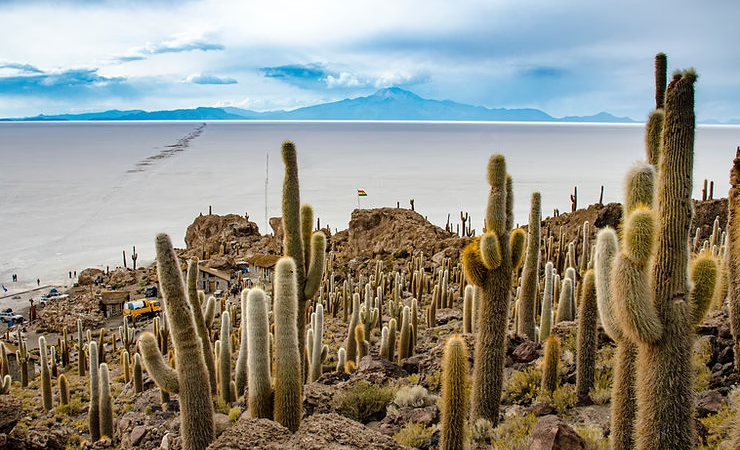
Key points to remember: Bolivia reveals an extreme biodiversity, where life explodes from the icy high plateaus to the Amazon jungle. To understand this flora is to discover fascinating survival strategies and a powerful traditional pharmacopoeia. This invaluable but threatened wealth urgently requires protection, as does the yareta, a green cushion over 3,000 years old.
Have you ever wondered how nature manages to flourish where climatic conditions seem impossible? We took a visual slap in the face as we set out to meetBolivia’s incredible flora – emblematic plants and shrubs, veritable warriors of the plant world. Prepare to be surprised by these extraordinary species, as this journey between the Andes and the Amazon will definitely change your perception of biodiversity 🌿.
- Altiplano flora: surviving at over 4,000 metres
- In the inter-Andean valleys: a milder garden?
- The exuberance of Bolivian Amazonia: another planet
- Bolivian pharmacopoeia: when plants heal and lift the spirit
- Protecting this plant treasure: a major challenge
Altiplano flora: surviving at over 4,000 metres
Yareta, the age-old green cushion
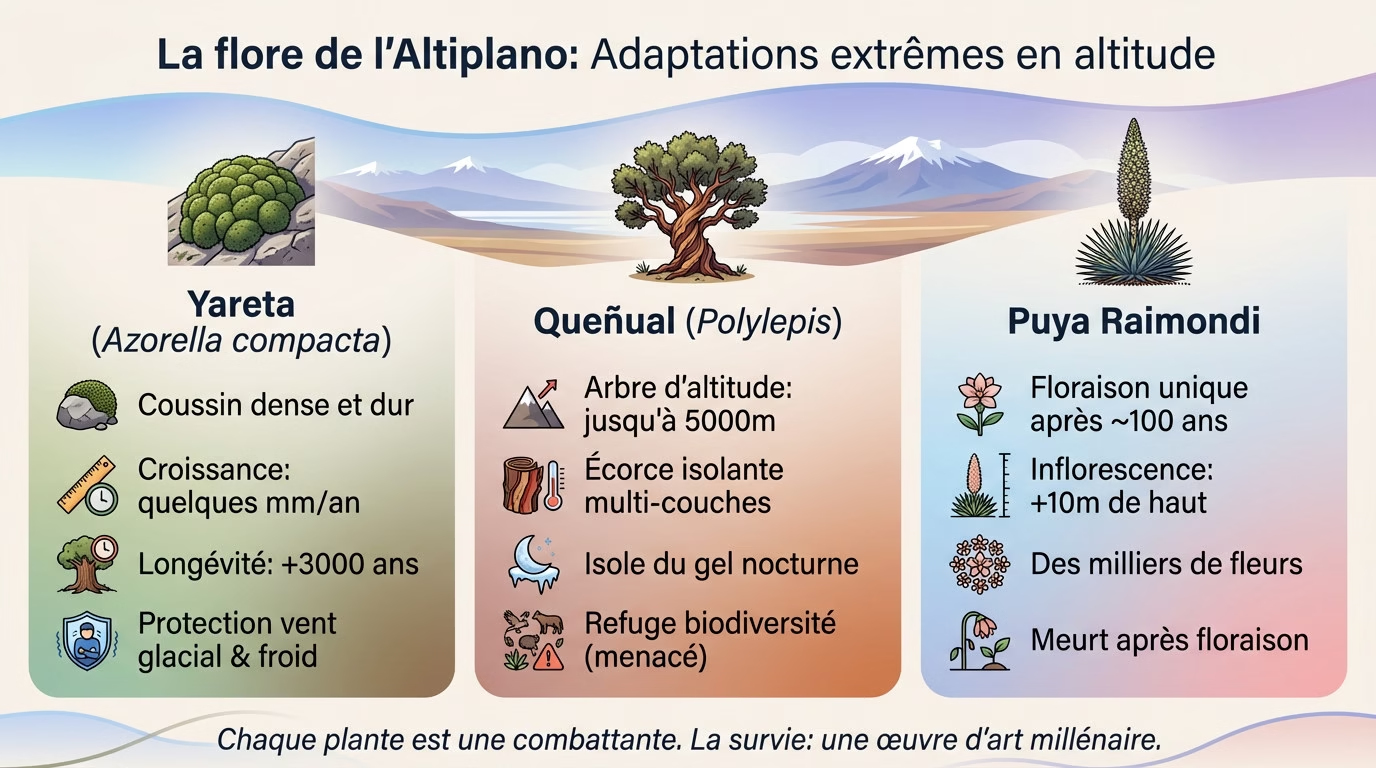
As you travel across the plateaus, you’ll discover Bolivia’s incredible flora, its emblematic plants and shrubs, including the yareta (Azorella compacta). This dense, hard green cushion is actually a colony of thousands of tiny plants.
Its compact form is a brilliant barrier against icy wind and extreme cold. It grows extremely slowly, just a few millimeters a year, enabling it toreach over 3,000 years 🤯.
To touch a yareta is to touch a living being that was here long before the Incas. It’s a real lesson in humility.
Queñual, the tree that defies altitude
The queñual (Polylepis) surprised us: it’s one of the tallest trees in the world. These twisted groves can be found up to 5000 metres, where nothing else grows.
Its bark is truly distinctive, composed of multiple paper-thin layers that exfoliate. This ingenious structure insulates the tree from the brutal night frost.
These forests are refuges of biodiversity, but they are unfortunately threatened by man. They are a fragile and precious ecosystem that must be protected.
The puya raimondi, a flowering plant unique in the world
The Puya raimondi is a true spectacle of nature that commands respect. It’s a plant that can live up to 100 years before flowering once and only once.
Its inflorescence is the largest in the world, a massive column up to 10 metres high containing thousands of flowers. An incredible sight to behold.
After this spectacular flowering, the plant dies, leaving its seeds to the wind. It’s the final touch to a lifetime of patience.
On the Altiplano, every plant is a fighter. Nature gives nothing away easily, and survival is a work of art that takes millennia to perfect.
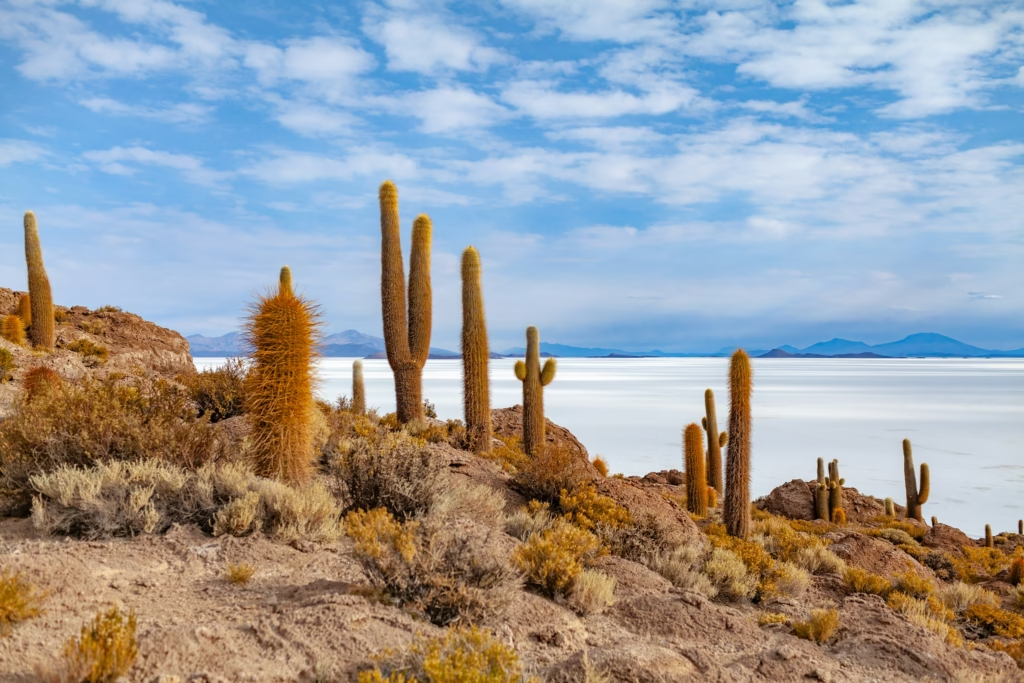
In the inter-Andean valleys: a milder garden?
After the thermal shock of the Altiplano, we finally descend to observe Bolivia’s incredible flora, its emblematic plants and shrubs. You’d think plant life would be easier in the valleys, but each environment has its own rules of the game.
Kantuta, the sacred flower of the Incas
Faced with such diversity, we came across the Kantuta (Cantua buxifolia). This is one of the country’s two national flowers. It’s immediately recognizable by its tubular flowers hanging in heavy fuchsia clusters.
For the record, it was a sacred flower for the Incas. They often used it in ritual ceremonies to mark the occasion and celebrate the unity of their people.
What blew us away was that its colors matched perfectly with the Bolivian flag:
- The bright red of the petals
- The yellow of the floral tube
- The green of the calyx
This coincidence reinforces its status as a national symbol.
Quinoa, more than just a seed
Forget the healthy trend, quinoa (Chenopodium quinoa) is first and foremost an ancestral plant from the Andes. It’s been the staple of the local diet for millennia, not just a “superfood”. Its resistance to drought is truly remarkable.
Bolivia is clearly one of the cradles of this culture. The diversity of varieties found here is impressive, light years ahead of what we see in our usual European supermarkets.
To find out more, take a look at this document on quinoa production.
The ceibo, the tree with coral flowers
We also came across the ceibo (Erythrina crista-galli). Its bright red flowers really do look like coral, hence its evocative nickname. It’s quite a sight when it’s in full bloom, believe us.
It grows mainly in the wetter parts of valleys. Its flowers attract a host of birds, especially hummingbirds, which love them. It’s a tree that symbolizes the vitality of these intermediate ecosystems.
The exuberance of Bolivian Amazonia: another planet
We leave the mountains for a radical change of scenery. Here, in the lowlands of the Amazon, the incredible flora of Bolivia’s emblematic plants and shrubs is fully revealed: nature isn’t fighting the cold, it’s exploding with life in fierce competition for light.
The patujú, the other national flower
We’ve got to tell you about the patujú (Heliconia rostrata), the country’s second national flower. It proudly represents the eastern, Amazonian part of the country, far from the Andes.
It looks crazy with its pendulous, colorful inflorescence. Its bright red bracts with yellow and green tips make it an instantly recognizable and spectacular plant.
For us, it perfectly symbolizes theexuberance and raw richness of the local Amazonian flora. 🌿
Forest giants and creepers
We came across giant trees such as the famous mapajo (Ceiba pentandra). Their massive trunks and buttress roots anchor these colossuses firmly to the jungle floor.
Under the canopy, the atmosphere changes as light struggles to penetrate the foliage. Creepers cling everywhere, creating a complex network that links the trees together. You really do feel tiny down there.
Each tree is an ecosystem in itself, home to countless other plants and animals.
Victoria amazonica, the giant water lily
Introducing Victoria amazonica, an aquatic wonder. It’s a water lily with leaves up to three meters in diameter. They float on the calm waters of Amazonian rivers and lakes.
Its leaves are strong enough to support the weight of a child. Its flowers are also remarkable: they open white at night and turn pink on the second day.
To stand in front of a field of Victoria amazonica at sunrise is to understand that nature has no limits in its excess and beauty.
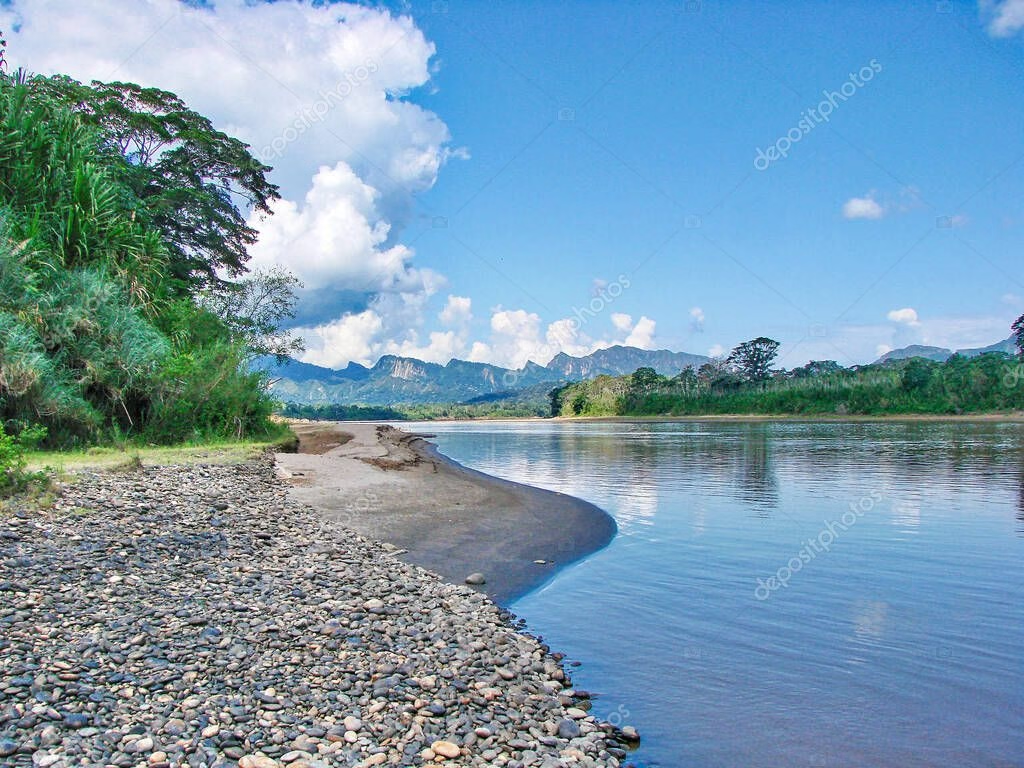
Bolivian pharmacopoeia: when plants heal and lift the spirit
But in Bolivia, many plants are more than just decorative. They have played a central role in daily life, traditional medicine and spirituality for centuries.
The coca leaf, a pillar of Andean culture
Forget the narco clichés about The incredible flora of Bolivia’s emblematic plants and shrubs. The coca leaf is first and foremost a sacred plant, a vital social cement for Andean peoples.
It’s easy to see that traditional consumption by chewing or infusion has absolutely nothing to do with purified cocaine.
Its traditional uses are many and have left their mark on us:
- It’s an effective appetite suppressant.
- A remedy for altitude sickness.
- An offering to the deities (Pachamama).
- A strong social bond between residents.
The san pedro cactus, gateway to the spirit world
We came across the San Pedro cactus (Trichocereus pachanoi) on our way. This large columnar cactus grows proudly in the Andes. It is best known for containing mescaline, a highly potent psychoactive substance.
The locals explained its use in Andean shamanism. It has been used for thousands of years for precise healing and divination rituals. It is a pillar of shamanic traditions for seeing the invisible.
Ayahuasca, the Amazonian soul vine
Then we discovered Ayahuasca, which we found quite mysterious. It’s not just a plant, but a complex preparation. It’s a powerful Amazonian shamanic beverage made from several plants.
The blend contains two main ingredients: Banisteriopsis caapi liana and Psychotria viridis leaves. It is their precise combination that produces the intense visionary effects sought in ceremonies. This herbal preparation remains a chemical mystery.
Protecting this plant treasure: a major challenge
This botanical wealth is incredible, but it’s also terribly fragile. Today, the question is not just to admire it, but to know how to preserve it for future generations.
Threats to Bolivia’s flora
This natural heritage is on a tightrope. The dangers are manifold and strike indiscriminately, from the Amazon plains to the Andean peaks. This is an alarming fact for Bolivia’s incredible flora, emblematic plants and shrubs.
We saw it for ourselves on our trip: whole swathes of forest are going up in smoke, and glaciers are retreating in leaps and bounds.
Here’s what’s eating away at the country:
- Rampant deforestation in the Amazon for intensive agriculture.
- Overgrazing, which damages Andean soils.
- Mining activities and climate change spare no one.
Yareta and queñual, symbols of fragility
Take yareta. Its hyper-combustible resin has made it too easy a source of energy for decades. It’s infuriating to think that millennia-old colonies have been reduced to ashes in just a few hours to keep warm. 😓
The same applies to the queñual. Its forests have been massively cut down for firewood and to free up grazing land. The problem is that its ultra-slow growth rate makes regeneration virtually impossible in the short term.
Conservation initiatives: hope for the future
Fortunately, all is not doom and gloom, and awareness is growing. National parks […] have been created to protect these unique ecosystems – a vital first step for biodiversity.
We’ve also seen community-based reforestation and sustainable management projects that give new hope. And botanical research continues to unearth new species, proof that there are still so many wonders to be saved there. 🌱
What a visual slap in the face! 🤩 To explore Bolivia’s flora is to go from an icy desert to an exuberant jungle in the blink of an eye. We hope this little overview has inspired you to protect these wonders. Nature here is as beautiful as it is fragile, so let’s take care of it together on our next adventures! 🌿🇧🇴

