Key takeaway: Nestled in the Apolobamba mountain range, the Kallawayas are more than just mountain people: they are itinerant healers with ancient knowledge. Discovering their world means understanding how nature and the sacred unite to heal, thanks to an incredible
What if the answers to our modern ailments were nestled in the Andes, far from the hustle and bustle of our daily lives? We set down our bags in the Kallawaya territory to observe how these itinerant doctors heal body and mind with astonishing precision. We’re taking you along to discover the secrets of this vibrant culture that still resists oblivion. 🌿
- Welcome to the Apolobamba mountain range, the heart of the Kallawaya world
- An open-air pharmacy: the secrets of the Andean ecosystems
- The Kallawayas: more than healers, spiritual guides
- A society organized around knowledge and rituals
- A fragile heritage facing present-day challenges
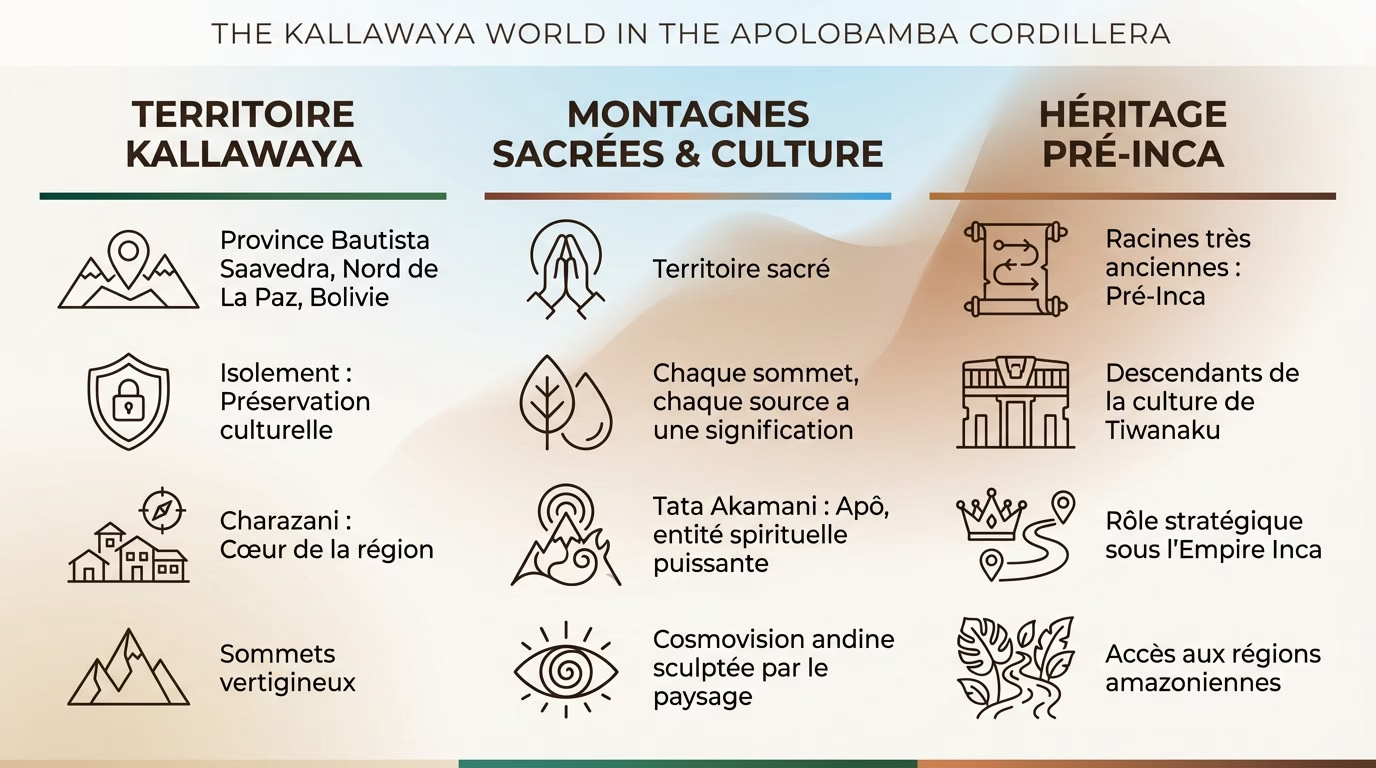
Welcome to the Apolobamba mountain range, the heart of the Kallawaya world
An isolated territory north of La Paz
We set down our bags in the province of Bautista Saavedra, far north of La Paz, Bolivia. Access is earned, not without difficulty, but it is this isolation that has protected the Kallawayas’ unique way of life in their territory.
Charazani stands out as the emblematic village, the provincial capital, and the true nerve center of the region. It is the inevitable starting point for understanding their fascinating world.
The dizzying peaks of Apolobamba encircle these valleys, creating a world apart, almost untouched. 🏔️
Sacred mountains, cradle of a culture
For the Kallawayas, these mountains are not just a backdrop for a photo. It is a sacred, living territory, where every peak and every spring tells a story that must be heard.
Take the Tata Akamani peak: it is more than a mountain, it is a spiritual entity, a powerful “Apô”. Here, the link between the raw earth and the spiritual is physical, direct.
Their cultural identity and Andean worldview are literally sculpted by this landscape. One does not go without the other.
A historical link dating back to the pre-Inca era
The roots of the Kallawayas are very ancient, dating back long before the Incas. They descend from the Tiwanaku and Mollo cultures. Their knowledge is not new; it is an ancient heritage estimated at over 1000 years.
During the Inca Empire, their role was absolutely strategic. The Carabaya-Kallawaya territory was a key access point to the Amazonian regions, which gave them a special status. They were clearly not subjects like any other.
An open-air pharmacy: the secrets of the Andean ecosystems
But this spectacular landscape is not just a backdrop. For the Kallawayas, it is above all a living library, a true open-air pharmacy.
The incredible richness of the three ecological levels
We quickly understood that their secret is not magic. Everything happens in the Kallawaya territory, which is far from uniform. In fact, it spans several distinct altitudes.
This vertical geography gives them direct access to an incredible variety of resources. This is the very basis of their recognized medical expertise.
Here are these three ecological levels and what you can find there:
- The subtropical zone, hot and humid, for certain specific plants.
- The temperate high valleys, ideal for the cultivation of corn and cereals.
- The cold and arid altiplano, domain of tubers and llama farming.
The Kallawaya pharmacopoeia, one of the most extensive in the world
Hold on tight, the numbers are dizzying. Their botanical pharmacopoeia includes approximately 980 different species. It is quite simply one of the richest found globally.
But it goes further than simple herbs:
Their knowledge is not limited to plants; it encompasses all living things, using a vast animal, mineral, and plant pharmacopoeia to restore balance.
This specialized knowledge has become the pillar of their local economy. They live from the care and rituals they provide everywhere.
Knowing how to read nature to heal
Their talent isn’t just about memorizing a list. We’re talking about a deep understanding of local ecosystems. They know exactly where to look. They master when and how to harvest each resource.
For them, illness is a disruption of balance with the environment. Healing, therefore, means using elements from that same environment to restore harmony. It’s a vision that seemed full of common sense to us.

The Kallawayas: more than healers, spiritual guides
But this intimate knowledge of nature would not exist without the men and women who carry and transmit it from generation to generation.
“The one who carries plants on their back”
In Quechua, the name Kallawaya literally means “the one who carries plants on their back“. It’s the raw image of the itinerant healer, traversing steep paths with their bag full of natural remedies.
These men — for the tradition is exclusively masculine — have always been great travelers. It is said that they traveled thousands of kilometers, from Panama to northern Argentina, to heal and exchange knowledge.
It’s amazing to realize the real impact of these itinerant healers of the Andes on local medicine.
The Andean worldview, the software of healing
Here, in the Kallawaya territory, everything is based on the Andean worldview. For them, health is not an isolated matter; it is a global balance between the individual, the community, nature, and the spirit world.
We quickly understood that healing requires respect for Pachamama and the Apôs. Rituals are obligatory, a strong cultural reality that earned their people recognition by UNESCO.
The Yatiris, readers of the future in coca leaves
Another aspect that amazed us: the yatiris, or spiritual guides. Their expertise goes far beyond simple physical care; it directly touches upon divination and the mysteries of the soul.
They use the reading of coca leaves as their primary diagnostic tool. This allows them to advise, guide life choices, and understand the spiritual blockages of a person or a community 🍃.
A society organized around knowledge and rituals
But the Kallawaya world is not limited to itinerant healers alone. It is an entire community, with its roles and rituals, that keeps this culture alive.
The essential, and often overlooked, role of Kallawaya women
We quickly understood one thing: if the men go far away to heal, the women are the pillars of the community. This is an aspect often overlooked, but without them, everything here would collapse because they actively participate in rituals.
Their role is very precise: they look after pregnant women and children, transmitting unique knowledge about motherhood. Above all, they are the guardians of memory through weaving, whose complex patterns tell their worldview.
Rituals, music, and secret language
The atmosphere changes radically when the music starts. We were captivated by the Kantus groups, who punctuate the ceremonies with their drums and pan flutes.
This music isn’t just for show; it serves to establish direct contact with the spirit world.
To understand how everything fits together, here’s what we observed:
- The healers (men), custodians of itinerant medicinal knowledge.
- Women, guardians of the home, weaving, and maternal care.
- Kantus musicians, mediators with the spiritual world during rites.
A crazy detail: they use a secret language during healing in the Kallawaya territory, to preserve the sacred, while they speak Quechua the rest of the time.
A simple life, rhythmic with the land
Outside of rituals, their daily life seemed very down-to-earth to us. They are primarily farmers and herders who work hard for their subsistence.
We saw them raising llamas and alpacas on the high altiplano, while cultivating potatoes and cereals in the valleys. They constantly exchange these products between the different altitudes.
A fragile heritage facing present-day challenges
Acculturation and the pressure of the modern world
Acculturation is hitting hard here. Young people are abandoning traditions for modernity, gradually leaving life in the Kallawaya territory. It’s a heartbreak for the community.
Kallawaya knowledge faces a double peril: lack of legal protection against large pharmaceutical companies and the erosion of its traditional transmission.
The 1952 Revolution shook everything up, accelerating their forced sedentarization towards cities. We saw healers become mere herbalists, losing that precious holistic vision.
Transmission, an increasingly tenuous thread
This knowledge is passed down through traditional father-to-son transmission, which is a double-edged sword. It’s beautiful, but if a generation breaks the chain, centuries of knowledge evaporate.
Here’s what concretely threatens this invaluable heritage:
- Mass rural exodus of younger generations to urban centers.
- Aggressive biopiracy carried out by large pharmaceutical companies.
- The extreme fragility of oral transmission.
Community tourism, a glimmer of hope?
Fortunately, encouraging community tourism initiatives are emerging. This is a unique opportunity to promote their culture while generating vital and sustainable income.
Here’s what the experience entails: incredible hikes in the Apolobamba massif 🏔️. As a bonus, you share their daily life, mystical rituals, and local crafts.
Exploring the Apolobamba mountain range was a real eye-opener for us. 🏔️ Between mystical peaks and ancient medicinal knowledge, the Kallawayas offered us an unforgettable lesson in humility. It’s a fragile but vibrant world that absolutely must be discovered with respect. So, ready to pack your bags for this timeless adventure? 🎒

