![Bolivia’s many ethnic facets [2026].](https://destination-bolivie.com/wp-content/uploads/2025/08/image-83-740x450.avif)
Here’s what you need to know: Bolivia is an incredible multi-national state, home to 36 recognized nations, from the Andes to the Amazon. Understanding this vibrant blend of indigenous roots and crossbreeding is the key to understanding the profound dynamics of this fascinating territory. An incredible human wealth, with almost 50% of the population proudly identifying with an indigenous community.
You think you know the Andes, but did you know that the real soul of this land lies in its human diversity, often unsuspected by travelers? We took a life lesson from exploring the many ethnic facets of Bolivia’s population, realizing that this country is a much richer patchwork of life. From the proud Aymaras of the Altiplano to the rhythms of the Afro-Bolivian Saya, we reveal the secrets of this unique cohabitation between 36 recognized nations, who every day reshape the face of the plurinational state 🇧🇴.
- The pillars of Bolivian identity: Quechua, Aymara and crossbreeding
- Beyond the Andes: the other faces of Bolivia
- Collas versus Cambas: the great regional divide
- The plurinational state: a revolution in politics and identity
- The paradoxes of Indianness: recognized but controlled
- Languages, religions and festivals: diversity in action
- Social realities and economic divides: the weight of ethnicity
The pillars of Bolivian identity: Quechua, Aymara and crossbreeding
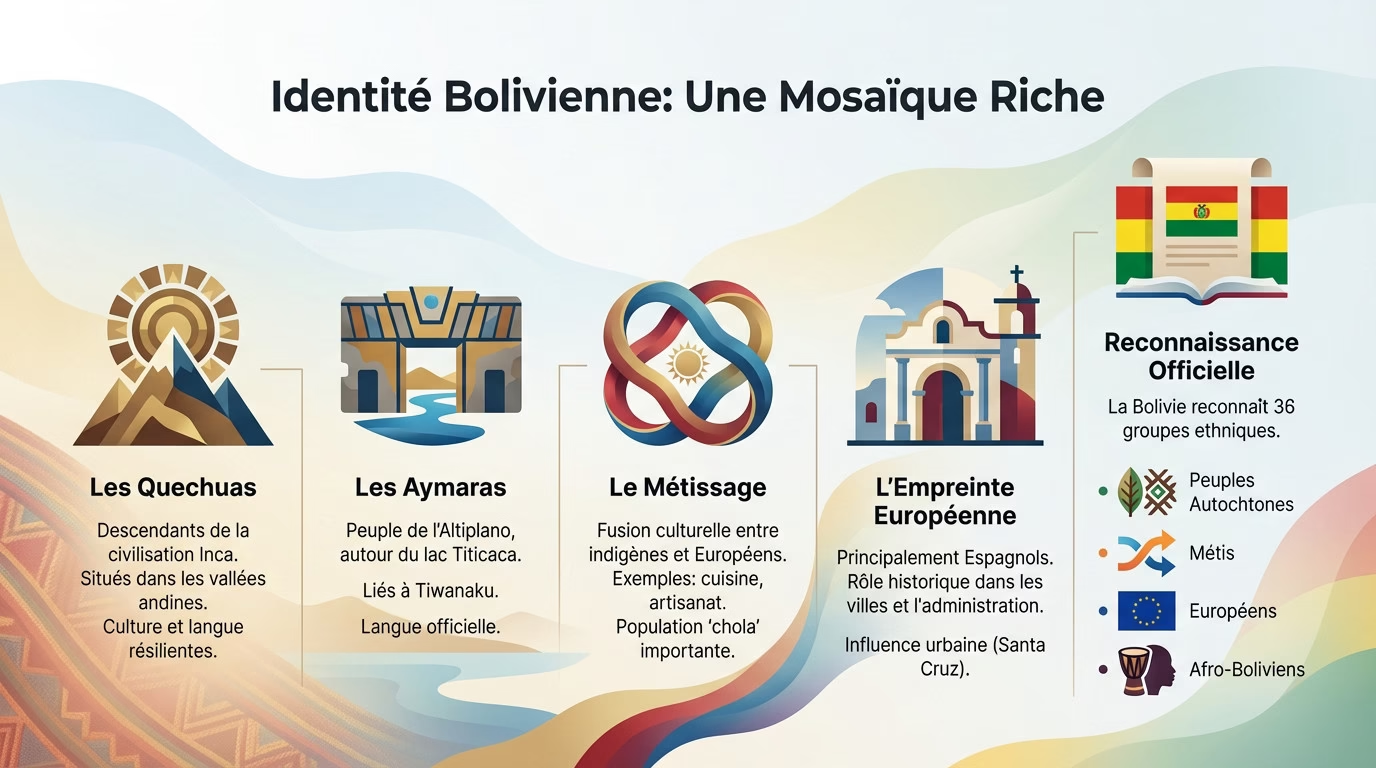
The Quechua, heirs to the Inca empire
It soon became clear that the Quechuas largely dominate the Andean landscape. They mainly occupy the inter-Andean valleys, where the climate is milder. They are the direct descendants of the mighty Inca civilization, and you can feel it everywhere. Their cultural heritage remains intact.
Their language still resonates loudly in the markets and streets. We assure you that their demographic weight is massive, impossible to ignore here. They are the most heavily represented indigenous group.
This culture survived the shock of the Spanish conquest, but not without difficulty. It still shapes daily life and traditions in the Andes.
The Aymaras, guardians of the altiplano
Higher up, on the icy Altiplano, reign the proud Aymaras. They live around Lake Titicaca, in harsh, cold lands. Their roots go back to the mysterious Tiwanaku civilizations, long before the Incas.
Their community organization struck us as incredibly solid and supportive. They don’t give up, and they carry a lot of weight in recent social movements. They’re a raw political force that we respect.
Aymara is also an official language, spoken with great pride. Their influence explodes in cities like El Alto and La Paz. These cities are the nerve centers of their culture 🇧🇴.
Crossbreeding, the cement of the nation
But Bolivia is also the story of a complex and omnipresent crossbreeding. This mixture is the result of centuries of cohabitation, sometimes forced, between natives and settlers. It is the beating heart of today’s society.
It’s not just about blood, it’s about culture. The local cuisine fuses Andean ingredients with Spanish techniques, a real treat. Handicrafts tell the same story. We call it cultural syncretism.
The figure of the “chola” perfectly embodies this mixed-race reality in everyday life. They make up a huge part of today’s population. They are the living bridge between the indigenous world and the West.
Europeans and their sustainable footprint
There was also a population of European descent, mainly Spanish. They laid the foundations for the cities and colonial administration of the time. Their historical role structured the country as we see it today.
Today, they are often concentrated in large, modern urban centers. They are often seen in Santa Cruz, the country’s economic powerhouse. Their political and financial influence remains highly visible.
Mind you, this group is by no means uniform, believe us. It includes descendants of Germans or Italians who arrived later. While they may be fewer in number, their impact is very real.
A state-approved mosaic
The state has come to officially recognize this incredible human diversity. The constitution now validates the existence of 36 distinct “nations” or ethnic groups in the country.
To make things clearer, here are the four main population blocks:
- Indigenous peoples (such as the Quechuas and Aymaras).
- Métis (the dominant indigenous-European mix).
- Europeans (mainly of Spanish origin).
- Afro-Bolivians (a unique community in the Yungas).
Understanding the multiple ethnic facets of Bolivia’s population explains everything. This official recognition is a game-changer when it comes to understanding the balance of power. It’s the key to understanding the country.
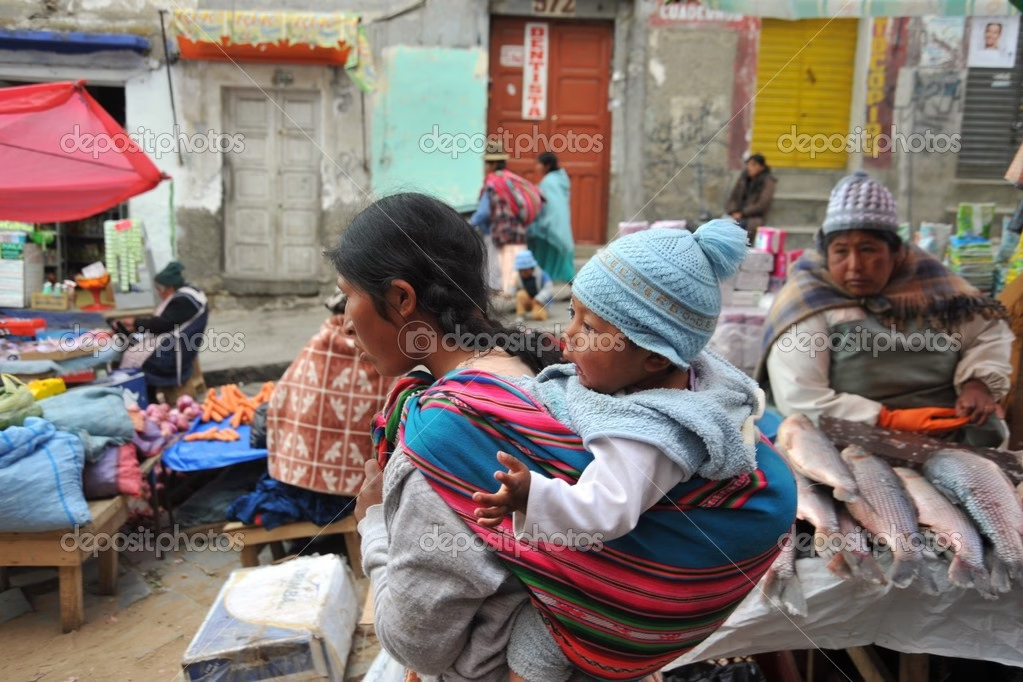
Beyond the Andes: the other faces of Bolivia
Think Bolivia is all about llamas and mountains? Big mistake. If you don’t look to the lowlands, you’ll miss out on unsuspected human realities that redefine the whole country.
The Guaranis, masters of the lowlands
We head south-east. There, far from the summits, live the Guaranis, a major indigenous group totally distinct from the Quechuas and Aymaras. They occupy the hot plains of southeastern Bolivia, in the arid region known as the Chaco.
What stood out for us was their connection to the land. Historically semi-nomadic, their culture is viscerally attached to the land. They wage continuous struggles, not without difficulty, to have their ancestral territories recognized in the face of outside pressure.
Don’t think it’s all in the past. Their language and traditions are alive and well today. It offers a completely different cultural perspective from that seen in the highlands.
Afro-Bolivians, a story of resilience in the yungas
The story of the Afro-Bolivians is a poignant one. They are the direct descendants of African slaves, deported during the colonial period to toil in the extreme conditions of the Potosí mines. They went through hell to enrich the Spanish crown.
To survive, they had to flee. They migrated to the subtropical Yungas region, north of La Paz. There, they finally found a milder climate and were able to establish their own farming communities.
Their culture is unique, as you can tell from the Saya dance. Their recent official recognition as a people represents a major political and cultural victory after centuries of invisibility.
The “forgotten peoples” of Amazonia
As you move deeper into the Amazon basin, you come across some thirty other indigenous groups. They are often less numerous, but essential. The Chiquitanos, Moxeños and Ayoreos who populate these green zones immediately spring to mind.
Each people has its own language and its own specific challenges. It’s a harsh reality: many are directly threatened by massive deforestation and the gradual loss of their vital territories.
Their existence proves that the multiple ethnic facets of Bolivia’s population are much deeper than one might think. It’s a veritable mosaic of human microcosms.
Mennonite communities, a world apart
A radical change of scenery with a surprising facet: the Mennonite communities. These are religious groups of European, rather Germanic, origin who immigrated to Bolivia during the 20th century to live out their faith.
Their way of life is puzzling: very isolated, traditionalist and refusing modern technology. They speak a German dialect, Plautdietsch, and live mainly from extensive farming in the warm Santa Cruz region.
The contrast between their timeless world and the rest of Bolivian society is striking. This inevitably raises complex questions about coexistence and environmental impact.
Japanese immigration and its legacy
Finally, there’s another wave of non-European immigration: the Japanese community. They didn’t arrive as tourists, but in several waves, particularly after the chaos of the Second World War.
They settled mainly in the departments of Santa Cruz and Beni. There, they founded prosperous farming colonies, such as Okinawa Uno, and introduced new, highly efficient cultivation techniques.
We were blown away by their successful integration while preserving their traditions. They clearly add another valuable layer to the cultural and economic diversity of this incredible country.
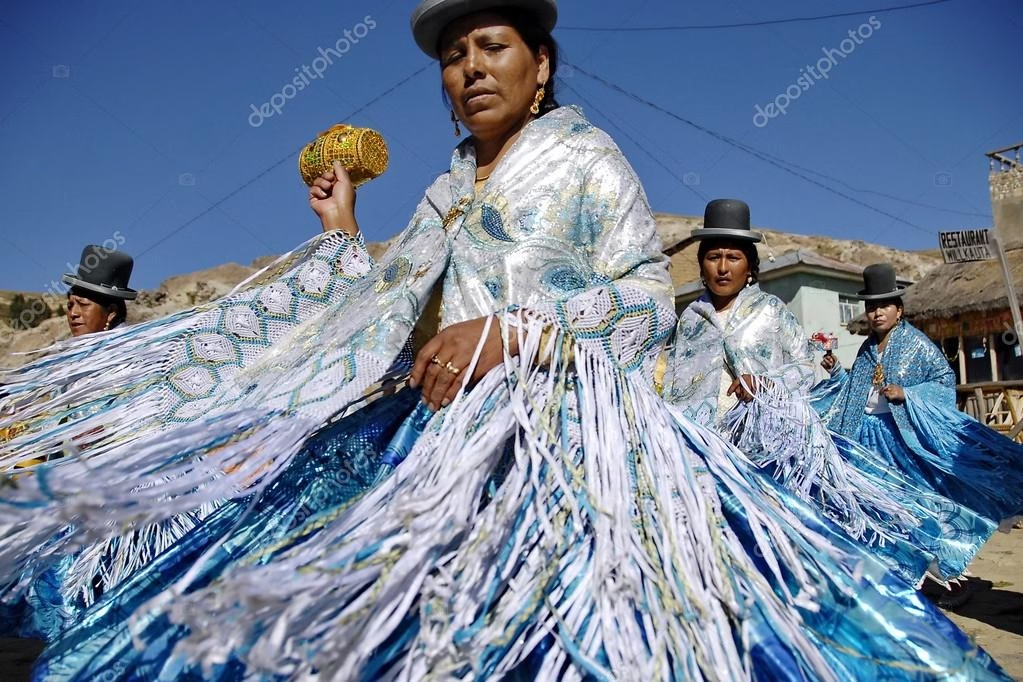
Collas versus Cambas: the great regional divide
Who are the “collas”? the identity of the highlands
We begin by defining the “Collas”. This term refers specifically to the inhabitants of the vast Andean region, encompassing the Altiplano and the valleys. These are the residents of emblematic cities such as La Paz, Oruro and Potosí, often perceived as the traditional face of the country.
This identity is inseparable from the Aymara and Quechua peoples. Their millennia-old history, culture and vision of the world are the foundation of this strong regional identity, rooted in the mountains.
Historically, this is Bolivia’s political and demographic heartland. Yet, paradoxically, this area is often associated with a certain poverty compared to the dynamism of the East.
Who are the “cambas”? the face of the Bolivian East
At the other end of the spectrum are the Cambas. This name describes the people of the eastern lowlands, the famous “media luna”. Everything revolves around Santa Cruz de la Sierra, the economic powerhouse that has been pulling the country upwards for the past few decades.
Here, Camba identity is built more on miscegenation and a more visible European ancestry. It is often defined, quite proudly, in direct opposition to the indigenous Andean world of the Collas.
This region is clearly wealthier, with a focus on modern agro-industry. It has no qualms about asserting its political and economic autonomy from central government.
Differences that can be heard and seen
The cultural differences are obvious to the eye, or rather to the ear. The Collas accent is quite guttural, closed, bearing the obvious mark of the Aymara and Quechua languages in everyday intonation.
In contrast, the Cambas accent is much more lilting and melodious 🎵. You can clearly feel the influences of neighbors like Brazil and Argentina. Vocabulary and expressions also change radically, sometimes creating an unexpected language barrier.
Beyond the language, it’s a whole temperament, a cuisine and a music that differ. You really get the impression that two distinct countries coexist, not without difficulty, within the same state.
A rivalry with deep roots
Don’t think it’s just folklore for tourists. This opposition is rooted in a complex economic and political history, creating a veritable territorial bipolarization that divides the nation in two.
To fully understand the many ethnic facets of Bolivia’s population, take a look at this striking contrast:
- Highlands (Collas): more populous, more Indian, poorer, historical political center.
- Lowlands (Cambas): economic engine, demands for autonomy, Mestizo/European identity.
This permanent tension between Collas and Cambas is an essential key to understanding the situation. It explains most of the recurring political crises, crystallized around the eternal debates on centralism and regional autonomy.
Insert a quote on duality
There’s a quote that perfectly sums up the divide that struck us during our stay. It reminds us that this geographical and human duality has been a fundamental, almost structural characteristic of the Bolivian nation since its inception.
“Bolivia is experiencing a territorial bipolarization that threatens its unity, pitting the Andean highlands against the eastern plains, which are demanding ever greater autonomy.”
The word “threat” is not chosen at random in this analysis. It underlines the extent to which this division remains a constant challenge to maintaining the national cohesion of a country with such clear-cut identities.
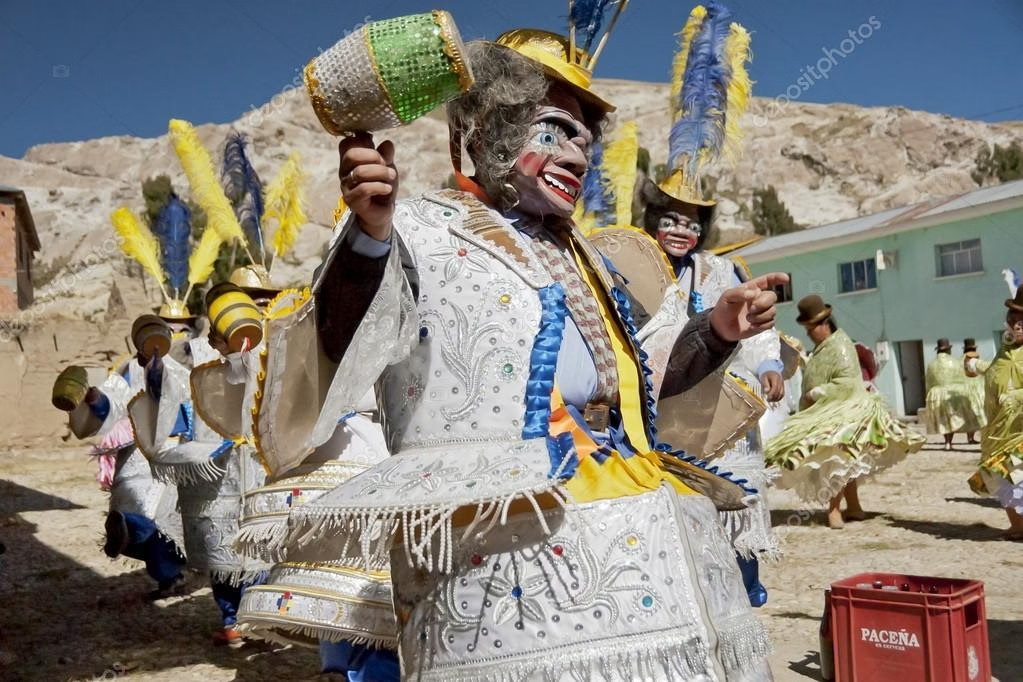
The plurinational state: a revolution in politics and identity
This permanent tension between the different facets of the country led to an attempt at complete refoundation: the proclamation of Bolivia as a Plurinational State. Let’s take a look at what this means in concrete terms.
The arrival in power of evo morales
In 2006, we witnessed a political earthquake: the election of Evo Morales. This was not just a change of head, but the arrival of the first indigenous president in the history of the country, and indeed of the continent 🇧🇴. A symbol of unprecedented power.
We’re telling you right now, it didn’t come out of nowhere. It was the explosive culmination of decades of relentless social struggle and the demands of indigenous movements. People wanted change.
He had a crazy plan: to radically transform the Bolivian state, basing everything on the recognition of its diversity. It was the opportunity of a lifetime to reshuffle the deck.
The 2009 constitution: the birth of the plurinational state
The cornerstone of this shift is the 2009 Constitution. This founding text officially proclaims Bolivia as a “plurinational state”. Quite a change of scenery for the institutions.
In concrete terms, the State recognizes the pre-existence of 36 indigenous nations and peoples. Gone is the myth of a single, homogeneous nation; we now speak of a state that is home to several distinct nations. This is official recognition of the multiple ethnic facets of Bolivia’s population.
This grants massive collective rights: autonomy, territory, language and its own justice system. This multi-ethnic and multi-cultural recognition dates back to 1994, but now we’re clearly going much further.
Concrete rights for indigenous peoples
Indigenous autonomies have sprung up everywhere. In these areas, communities can govern themselves according to their own habits and customs. It’s a freedom of management that we hadn’t seen coming.
Even more surprising is the recognition of indigenous community justice. It now coexists with ordinary state justice. It’s a major change that shakes up established codes, sometimes with difficulty.
As a bonus, indigenous languages are valued as never before. They gained official status on a par with Spanish, and were taught in schools. In short, a true cultural revolution.
Vivir bien” as the new paradigm
One concept particularly impressed us: “Vivir Bien” (Suma Qamaña in Aymara), written in black and white in the constitution. It’s a profound Andean philosophy of good living, far removed from materialism.
We define it as a search for harmony between humans, and above all with Pachamama (Mother Earth). It’s a radical alternative to the Western development model we all know 🌿.
This principle is supposed to guide all public policies in the plurinational state. Well, we found it complex to apply concretely, and it’s much debated, but the intention remains strong.
A symbol for the whole of Latin America
The Bolivian model has had an enormous impact throughout Latin America and beyond. We felt that the country was becoming a political laboratory observed everywhere.
It’s clearly one of the world’s most far-reaching attempts to decolonize the state. The aim? To build a truly intercultural society. We’ve had absolutely no regrets about looking into this unique experiment.
Despite its difficulties, the Bolivian experience has opened up a fundamental debate. It questions the very nature of the nation-state and the real place of indigenous peoples. Makes you think, doesn’t it?
The paradoxes of Indianness: recognized but controlled
The fall of indigenous self-identification
It’s the kind of figure that comes as a cold shower. While official discourse celebrates The multiple ethnic facets of Bolivia’s population, the 2012 census revealed a sharp drop. We’ve gone from 62% indigenous self-identification in 2001 to just 41%. This is a sharp and unexpected decline.
Have we changed the way we count? Maybe people just prefer to call themselves “mestizo” or just “Bolivian” today. It seemed like quite a turnaround to us.
This finding caused a political earthquake in the region. We invite you to analyze this 2012 census that profoundly questions the meaning of today’s identity.
When the state defines a “good” native
We quickly realized that the multi-national model has its limits. In trying to protect these cultures, the state ends up standardizing them and over-idealizing them. That’s the other side of the coin.
A complex reality lies behind the slogans, as this pertinent observation underlines:
“The plurinational state, despite its rhetoric, exercises a control and idealization of Indianness that paradoxically contributes to the dissolution of that very identity.”
Basically, the state decides on the criteria for being a “true” native. This creates a somewhat fixed official version that doesn’t always fit with what people really experience on a daily basis.
Indigenous justice under trusteeship
Take the case of indigenous justice, often cited as an example. On paper, it’s a major step forward, but on the ground, it’s not easy. Autonomy remains, frankly, relative.
The State is constantly seeking to make it “compatible” with classical law. The Plurinational Constitutional Court keeps the upper hand. It does not hesitate to control practices in the name of the famous “Vivir Bien” concept.
We find ourselves with a justice system that is theoretically free, but ultimately closely supervised. The Tribunal uses the vivir bien to define the limits acceptable to the central power.
Urban Indianness, the great challenge
Here’s another contradiction that jumped out at us. Political discourse almost invariably associates the indigenous with the countryside, the land and isolated community life.
And yet, Bolivia has been a predominantly urban country since the 1980s. Millions of Aymaras and Quechuas work in the city, especially in the giant anthill of El Alto.
The problem is that the current model is having trouble capturing this urban Indianness. These city dwellers are reinventing their own codes, far from the rural cliché that the state is so fond of promoting.
The return of métissage as a refuge identity?
Coming back to the drop in numbers, we wonder. Isn’ t the “mestizo” identity finally becoming the most comfortable option for many Bolivians? It seems plausible.
Let’s not forget that back in the 50s, the MNR was already advocating a nation based on the “Indo-Métis race”. At the time, the political objective was clear: to assimilate the natives into a single mold.
This raises a serious question. Is this return to miscegenation a free choice or the consequence of an indigenist policy that sets the bar far too high for the average citizen?
Languages, religions and festivals: diversity in action
Having looked at the political context, let’s get down to the nitty-gritty of what is really lived and felt on a daily basis. You’re probably wondering how this incredible diversity manifests itself in Bolivian popular culture?
A country that speaks over 30 languages
We quickly realized that Bolivia’s rich linguistic diversity perfectly illustrates the many ethnic facets of its population. While Spanish is still the most widely spoken language on the streets, it is far from the only master on board.
Quechua and Aymara still resonate strongly, spoken by millions of proud locals. But that’s not all: there are also dozens of other lesser-known dialects, such as Guarani and Chiquitano.
Unfortunately, a silent drama is unfolding, as many of these idioms are in danger of extinction. According to some demographic data, 42 living languages are struggling to keep their world view alive.
Religious syncretism: when the pachamama meets the Virgin Mary
Bolivia is predominantly Catholic, that’s a fact, but forget everything you know about classical Catholicism. Here, faith has a unique flavor, totally steeped in ancient pre-Columbian Andean beliefs.
It’s called syncretism, and frankly, it’s amazing to observe first-hand. The Virgin Mary is often confused with Pachamama, Mother Earth, and Catholic rituals almost always end with offerings to the ground.
This fusion has been seen absolutely everywhere, from huge urban basilicas to tiny village chapels. It’s a peaceful and creative coexistence of beliefs that gives meaning to local spirituality.
Carnaval d’oruro, a masterpiece of folklore
If there’s one time when this cultural mix explodes, it’s at the Oruro Carnival. Listed by UNESCO, it is without doubt the most spectacular and vibrant example of this unique hybrid culture.
We were stunned by its star dance, the famous Diablada, which mimics the struggle between the Archangel Michael and the demons. Except that these “demons” actually come straight from pre-Hispanic mining beliefs, embodying the Tío de la mina.
In short, this carnival is a visual slap in the face, an explosion of color and faith. Thousands of dancers celebrate this dual identity, both Catholic and indigenous, with infectious joy. 🎉
Music and dance, the soul of each region
Music is a serious business here, and changes radically with every kilometer travelled. Each region, each people has its own rhythms, its own instruments and draws us into its own frenetic rhythm.
- Afro-Bolivian Saya, rhythmic and powerful.
- Les Caporales, a vibrant Métis dance
- Tinku, the intense ritual combat of the Andes.
- Chacarera, typical of the Chaco region.
For us, this music is much more than just folklore for tourists. They are powerful identity markers through which Bolivians proudly shout out who they really are.
Gastronomy, a blend of cultures on the plate
When it comes to cuisine, get your taste buds ready, for this is another simply brilliant fusion ground. Ancient Andean ingredients meet techniques imported by the Spaniards, often with surprising results.
Imagine hundreds of potato varieties, quinoa and corn married to beef or pork. We feasted on the juicy Salteña and the hearty Pique Macho, a challenge for big appetites. 😋
There’s also a real contrast between the heavy dishes of the Altiplano and the freshness of the lowlands. There, the exotic fruits and fish of the Amazon change the face of the dish.
Social realities and economic divides: the weight of ethnicity
Ethnicity, a marker of inequality
Let’s face it, history has been tough. Poverty affects the many ethnic facets of Bolivia’s population differently, with the indigenous populations having historically been the most marginalized.
In concrete terms, this can be seen on the ground: access to schooling or healthcare remains more complicated. This is even more obvious in the isolated rural areas where many of these communities live.
Even if things are moving a little, these structural inequalities are still very much with us. It’s a huge challenge that still weighs heavily on the country’s daily life and holds back social equity.
Aymara vs Quechua: different destinies?
We tend to lump everything together, but that’s a mistake. Studies point to real differences in living standards between Aymaras and Quechuas 📊.
The Aymaras often fare better thanks to an ironclad community solidarity. Their strong presence in fast-moving urban centers such as La Paz and El Alto clearly plays to their economic advantage.
In contrast, the Quechua are often more scattered across the agricultural countryside. This geographical dispersion can make them more vulnerable to the economic crises that hit rural areas.
The question of land, a permanent conflict
If there’s one subject that really gets people riled up, it’s land ownership. It’s the sinews of war, the source of historical tensions that continue unabated today.
Demands for Tierras Comunitarias de Origen (TCOs) have been multiplying everywhere. Peoples want to reclaim their ancestral territories, but the administrative machinery is slow and blockades are frequent 🚜.
Opposite, Santa Cruz’s agro-industry is pushing hard to expand. This head-on clash between two visions of the world creates an electric atmosphere, ready to explode at any moment.
Migration and urbanization: new dynamics
The face of the country has changed in recent years, with a massive rural exodus. Millions of Bolivians, most of them indigenous, have left their homelands to try their luck in the city, the opportunity of a lifetime.
Look at the mad growth of El Alto, just above La Paz. It has become a gigantic Aymara metropolis where traditional identities are being transformed by urban modernity.
While the city offers opportunities, precariousness often lurks around the corner. We lose some of our village ties, but we also see the emergence of a fascinating new “chola” bourgeoisie.
Racism, a taboo that persists
We can’t finish without talking about racism and discrimination. Even if the constitution says otherwise, these old demons have unfortunately not disappeared from the Bolivian landscape 🚫.
It’s often insidious, hidden in a look or a remark about a family name. Skin color, accent or the simple fact of wearing a pollera are enough to trigger contempt.
A law exists to punish this, it’s true, and it’s a good start. But changing entrenched mentalities will take time, and that’s what’s needed to build a Bolivia where everyone has a place.
Ultimately, to explore Bolivia is to plunge into a fascinating human mosaic! 🇧🇴 From the Altiplano to the tropical plains, we were struck by this unique cultural richness where ancestral traditions and modernity coexist. This trip to the heart of the plurinational state proved that diversity is indeed this country’s greatest strength. ✨

